Using AI to write a simple brand voice guide from your existing emails and social posts so any contractor or new hire writes like you
Build a brand voice guide small business owners can actually hand to freelancers — using emails you've already written and a free AI tool. Takes about an hour.
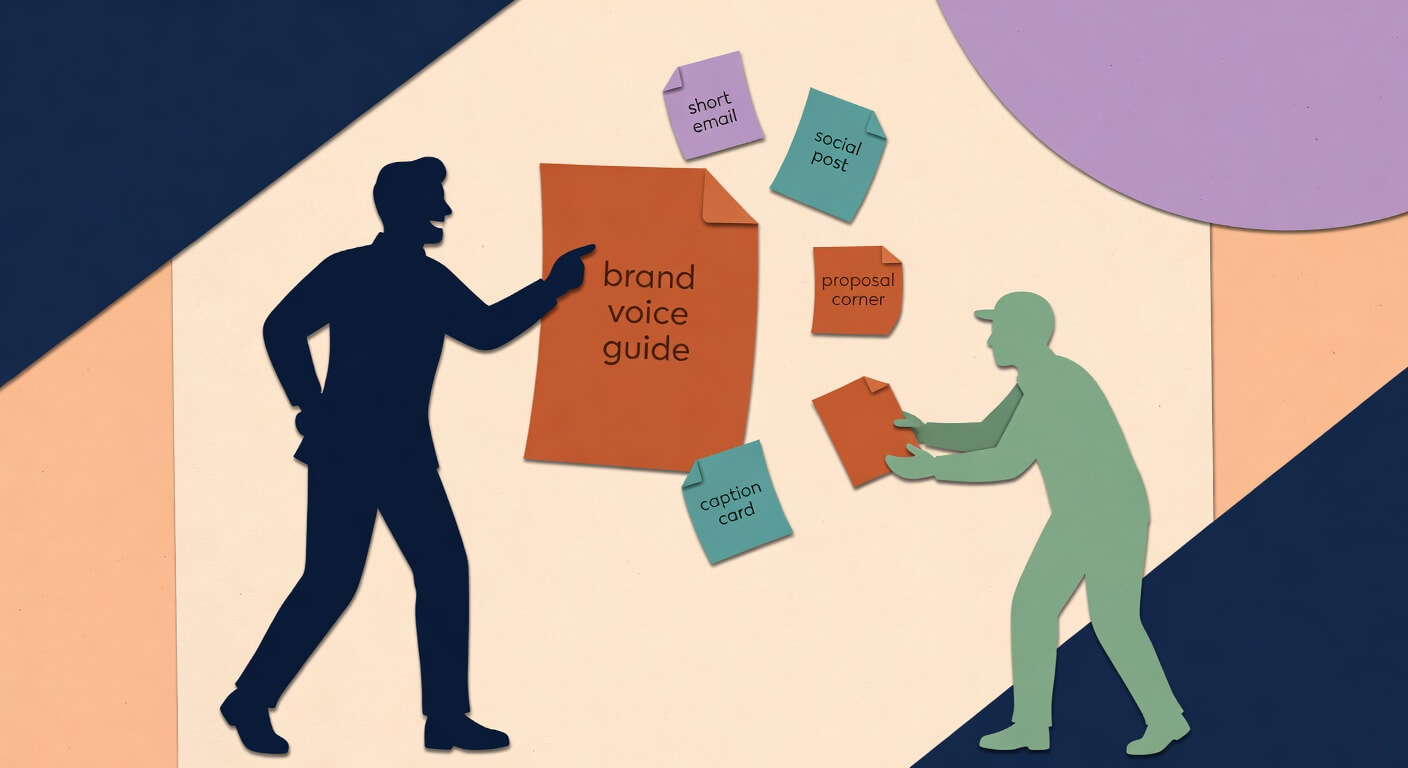
You hired a freelancer to write three client emails, got them back, and spent two hours rewriting every single one from scratch — because they were technically fine but sounded nothing like you. This post shows you how to build a simple brand voice guide small business owners can hand to any contractor, using writing you've already done. The whole thing takes about an hour, using AI tools you probably already have access to for free.
What you need before you start
ChatGPT{:target="_blank"} — OpenAI's AI tool that you type or paste things into and it responds in plain English; the free version (GPT-4o with some daily limits) is enough for this whole workflow. If you'd rather use Claude{:target="_blank"} (Anthropic's AI, also free to start) or Gemini{:target="_blank"} (Google's AI, free, and it works inside Google Docs if that's where you live), those all work just as well here.
Time required: About 60–75 minutes the first time. Maybe 20 minutes if you ever need to update it.
Skill level: If you can copy and paste text and type a question into a search bar, you can do this. That's genuinely all the technical skill involved.
Pull together your raw material
Think of this like gathering ingredients before you cook. You don't need anything fancy — just writing you've already sent out into the world.
Open a blank Google Doc or Notes app — somewhere to collect everything in one place before you touch any AI tool.
Find 5–10 emails you've sent to clients. Look for variety: a welcome email, a follow-up, a tricky situation you handled, a project update. You want the AI to see how you write in different moods, not just your best day.
Grab 5–10 social captions or posts — Instagram, Facebook, LinkedIn, wherever you post. Again, mix it up. Don't curate only your favorites.
Add one or two extras if you have them — a proposal intro, an FAQ page, a section of your website. Not required, but helpful.
Paste it all into your collecting doc and label each chunk loosely: "Email — new client welcome," "Instagram caption — before/after," etc. You don't need perfect labeling. Just enough so you remember what's what.
One thing worth knowing: if you have fewer than five pieces of writing, the AI can still help, but it'll lean heavily on surface-level stuff like punctuation habits and sentence length rather than picking up on the real tone underneath. Aim for at least 8–10 varied samples for the most accurate results.
Build your brand voice guide with the two-pass AI prompt
Here's where most people try to rush it — pasting everything in with one big prompt and hoping for magic. The smarter move is two passes. Pass one gets the AI to read your writing and describe what it notices. Pass two turns those observations into an actual guide. Skipping straight to pass two tends to produce something generic and vague, like "your tone is professional yet approachable." Not useful.
Pass 1 — the analysis prompt
Open your AI tool of choice, start a new conversation, and paste in all your writing samples. Then, right after the last sample, add this prompt:
Read all of the writing samples I've pasted above. Don't write a guide yet. Instead, describe what you notice about how I write: my tone, my sentence length, the words I use often, the words I seem to avoid, how formal or casual I am, how I handle difficult or sensitive topics, and anything else that feels consistent. If you notice inconsistencies — places where my voice shifts — point those out too. Give me your observations in plain language, not bullet points of adjectives. I want to understand what you're seeing.
What you'll get back is a paragraph or two of observations — almost like someone who's read all your writing telling you what they noticed. Read it carefully. It's often a little surprising. Most business owners have habits they weren't aware of.
Pass 2 — turning observations into a guide
Don't start a new conversation. Stay in the same thread and send this follow-up:
Now use those observations to write me a simple brand voice guide. Format it like this: (1) A tone description — 3 to 5 adjectives with a one-sentence explanation of each. (2) A "we say / we don't say" table with at least 8 word-swap examples — specific words or phrases, not vague categories. (3) Two short sample paragraphs with brief notes explaining what makes them sound like me. (4) A short list of topics I handle carefully or avoid. Keep the whole guide to one to two pages. Write it as if you're briefing a freelancer who has never met me.
The "we say / we don't say" table is the most important piece of this whole guide. It's the section where a contractor can look at a word they just typed and immediately know whether it fits. Abstract adjectives like "warm" or "approachable" mean different things to different people. A table that says we say "you'll get" not "you will receive" — that's unambiguous.
Review, fill the gaps, and format it to actually get used
AI pattern-matching is good. It's not perfect. Read through what it produced and ask yourself a few honest questions.
Does the tone description sound like you, or does it sound like a generic small business? If it's too generic, go back into the same conversation and say: "The tone section feels a bit generic. Here's one thing about how I write that you didn't capture: [describe it in a sentence or two]. Please revise the tone section to include this."
Does the word-swap table have at least 8 rows? If it only gave you 4 or 5, ask for more: "Add 5 more rows to the word-swap table. Focus on words I might use in client-facing emails and social captions."
Is there a topic you're careful about — pricing, competitors, a specific issue in your industry — that didn't make it into the "topics we handle carefully" section? Add it yourself. You know your business better than the AI does.
Once you're happy with it, copy the whole thing into a clean Google Doc or a Word file and save it as a PDF. One page if possible. Two at most. A contractor will read a one-page PDF before starting a job. They will not read a ten-page document — and honestly, you wouldn't either.
Hand it off in a way that actually changes what they produce
The guide only works if it's in front of the contractor before they start writing — not as an afterthought when you're already on revision round two. Attach it to your project brief the same way you'd attach a logo file or a password doc. Make it a standard part of how you kick off any writing work.
Upwork{:target="_blank"} explicitly recommends including a brand voice doc in your project brief — buyers who do this report fewer revision rounds. It's one of those small upfront investments that pays back immediately on the first draft.
If you use a repeating onboarding checklist for new hires or contractors, add "send brand voice guide" as a step. Otherwise it'll live in your Google Drive and never actually reach anyone.
When something goes wrong
The guide sounds too generic — like it could belong to any business. This usually happens when the writing samples were too similar to each other (all formal emails, no casual posts) or too few. Go back and add more varied samples — especially anything where your personality comes through most clearly — and run pass one again.
The AI says my writing is inconsistent. That's not a failure. That's useful information. It means you write differently across channels — which is actually fine and often intentional. If you're more formal on LinkedIn and loose on Instagram, tell the AI that explicitly: "I intentionally write differently by channel. Please document the LinkedIn voice and the Instagram voice as two separate profiles rather than averaging them together." Then you'll have a guide with two short sections instead of one muddled one.
The word-swap table has vague entries like "casual vs. formal." Push back on it. In the same conversation, say: "The word-swap table needs to be more specific. Instead of categories, give me actual word examples — specific phrases I'd use versus phrases I'd avoid." Usually one nudge fixes this.
What to do next
Save the guide, attach it to your next contractor brief, and see what the first draft looks like. If the contractor still misses the mark, look at which part of the guide didn't give them enough to work with — and add one more example there. The guide gets better every time you use it.
If you want to go further and use AI to help write your actual client emails and marketing copy once your voice is documented, check out the walkthrough on briefing AI to write in your brand voice with a style brief.
FAQ
Do I need a paid AI subscription to build a brand voice guide for my small business? No. The free tiers of ChatGPT{:target="_blank"}, Claude{:target="_blank"}, and Gemini{:target="_blank"} are all enough for this workflow. The main limit on free plans is how much you can paste in one session — if you hit a wall, just split your samples into two separate conversations and combine the observations yourself before running pass two.
What if I've only been in business a year and don't have much writing to pull from? Use what you have, even if it's only five or six pieces. The guide will be a bit thinner, but it's still more useful than nothing. You can always revisit it in six months once you have more to work with. A short, honest guide beats no guide every time.
Can I use this to document a team member's writing style, not just my own? Absolutely. Gather samples of their writing — emails they've sent, content they've created — and run the same two-pass process. This works especially well when a team member has a strong client relationship and you want to maintain continuity when someone else starts helping with their communications.
How often should I update my brand voice document? Whenever something feels off. If you notice a new contractor is missing the mark in a specific way, that's a signal that the guide has a gap. Add an example, update the word-swap table, and move on. Realistically, a light refresh once a year is plenty for most small businesses.
What if I write really differently than I want my brand to sound? Good question — this comes up more than you'd think. If your current writing has habits you want to move away from, tell the AI that during pass two: "My current writing has [habit]. I want the guide to reflect where I want my voice to go, not just where it is now." Then give it two or three examples of writing you admire and ask it to blend your patterns with those. You'll still need to coach contractors on the new direction, but at least you'll have something concrete to point to.
Prompts from this article
Analyze Your Writing Style and Tone
Use this after pasting your writing samples (emails, social posts, etc.) into a new AI conversation. This is the first pass — it gets the AI to analyze your writing before building the guide, which produces much more accurate results than skipping straight to guide creation.
Create a Brand Voice Guide for Contractors
Use this as a follow-up in the same conversation, immediately after receiving the AI's observations from the analysis pass. This second pass turns the AI's analysis into an actual brand voice guide formatted for handing off to contractors or new hires.
Revise a Generic Tone Section in Your Voice Guide
Use this in the same conversation if the generated tone description sounds like it could belong to any business rather than yours specifically. Replace the bracketed placeholder with your own observation.
Expand a Word-Swap Table for Brand Voice
Use this in the same conversation if the word-swap table only produced a few entries and needs to be more comprehensive for practical contractor use.
Make a Word-Swap Table More Specific and Concrete
Use this in the same conversation if the word-swap table returned vague category-level entries like 'casual vs. formal' instead of concrete word-for-word substitutions.
Create Separate Voice Profiles for Each Social Platform
Use this in the same conversation if the AI flags your writing as inconsistent and you want separate voice profiles per platform rather than one blended guide. Adjust the platform names to match whichever channels you actually use.
Write an Aspirational Brand Voice Guide
Use this during the second pass if your existing writing has habits you want to move away from and the guide should document an aspirational voice rather than your current one. Replace the bracketed placeholder with the specific habit you want to leave behind.
Read Next
How to use AI to turn your customer discovery call notes into a repeatable sales script your whole team can use without sales training
MarketingHow to use AI to prepare a simple brief before you brief a social media manager or content agency so you stop paying for content that misses
MarketingHow to use AI to write a simple email sequence that re-engages your cold subscriber list before you delete it and start over